Datafication is often portrayed as a revolutionary development within and beyond educational governance. It is believed to usher in novel modes of governance, foster new relationships between private and public entities, and introduce innovative data technologies along with new forms of research and scholarship.
Amid the prevailing focus on what’s new , Antti Saari examines the ghosts of data futures past. He delves into the historical continuities of datafication in education, shedding light on the overlooked aspects of past data revolutions and their varying success in driving substantial changes within the field of education.
In a recent article in Sociological Research Online Antti Saari, together with Kristiina Brunila and Saara Vainio (University of Helsinki) analyze the assemblages involved in constructing the university student as a mentally vulnerable individual.
Abstract: Public debate and media attention concerning mental health problems, stress, psycho-emotional vulnerabilities, and anxiety among university students has reached record level. Informed by media representations, student mental health guides, and our observations, we focus on the ethos of vulnerability as an articulation of psychologized student subjectivity in Finnish academia. We explore the multiple registers in which the ethos of vulnerability tends to operate as an assemblage to depict and govern student subjects.
You can access the OA article The Psychologization of Student Subjectivity in the Finnish Academia here.
In a recently published article in Philosophical Inquiry in Education, Antti Saari and Jan Varpanen discuss the cultivation of desire from a psychoanalytic point of view.
Abstract: Taking Marcel Proust’s In Search of Lost Time (À la recherche du temps perdu) as a literary vehicle, this article uses a psychoanalytic lens to examine the problem of what to do with our desires in the philosophy of education. The article describes an apprenticeship, a personal process of learning in which an ethical rapport with desire can be established. Apprenticeship entails a temporal relationship called “afterwardsness” (Nachträglichkeit), in which the subject constructs the truth of its desires in hindsight. This result can only be achieved by first failing to see the possibility of attaining the object of desire and then eventually coming to understand the nature of desire in general. While others have framed the relationship between desire and education in terms of either fulfilling one’s desires or questioning their desirability, we argue that a more lasting ethical attunement to desire can be found via an apprenticeship in failure.
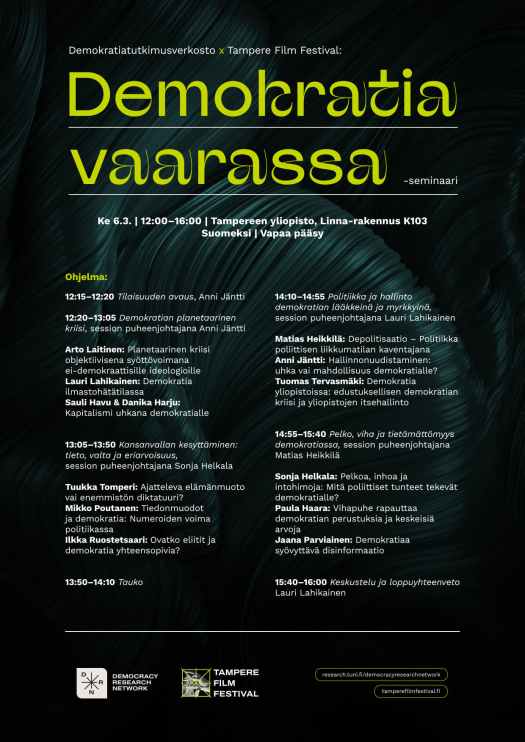
Tampereen yliopiston Demokratiatutkimusverkosto oli mukana järjestämässä Demokratia vaarassa -nimellä kulkevaa ohjelmistokokonaisuutta tämän vuoden Tampereen elokuvajuhlilla. Kokonaisuus koostui näytöksistä, näytösten yhteydessä järjestetyistä paneelikeskusteluista sekä Tampereen yliopistolla pidetystä seminaarista.
Keskiviikkona 6.3.2024 järjestetyn Demokratia vaarassa -seminaarin tarkoituksena oli tuoda esiin Tampereen yliopistossa tehtävää monipuolista demokratiatutkimusta ja erilaisia näkökulmia siihen, millä tavoin demokratia on vaarassa. Seminaarissa eri alojen tutkijat kertoivat tiiviisti oman tutkimuksensa näkökulmasta demokratian vaaroista. POISED-tutkimusryhmän tutkijoista seminaarissa esityksen pitivät Tuomas Tervasmäki, Tuukka Tomperi ja Sonja Helkala, joka oli myös järjestämässä Demokratia vaarassa -ohjelmistokokonaisuutta. Tuomas Tervasmäki käsitteli yliopistodemokratiaa puheenvuorossaan “Demokratia yliopistoissa: edustuksellisen demokratian kriisi ja yliopistojen itsehallinto”. Tuukka Tomperi puhui demokratian uhkakuvista otsikolla “Ajatteleva elämänmuoto vai enemmistön diktatuuri?” ja Sonja Helkala käsitteli poliittisten tunteiden ja demokratian suhdetta esityksessään “Pelkoa, inhoa ja intohimoja: Mitä poliittiset tunteet tekevät demokratialle?”. Seminaarin muissa puheenvuoroissa lähestyttiin demokratian vaaroja muun muassa ilmastohätätilan, eliittien, hallinnonuudistamisen, disinformaation ja depolitisaation näkökulmista.
Seminaarin lisäksi ohjelmistoon kuuluivat näytösten yhteydessä järjestetyt paneelikeskustelut. Torstaina 7.3. Arkipäivän demokratia -paneelikeskustelussa olivat mukana elokuvaohjaaja ja käsikirjoittaja Mia Halme, kirjastonhoitaja Marjo Hietikko, sosiaalipolitiikan professori Päivi Kymäläinen sekä politiikan tutkimuksen tutkijatohtori Aino Tiihonen. Keskustelua moderoi Anni Jäntti. Perjantaina 8.3. ohjelmistokokonaisuus huipentui Kansalaisaktivismi-näytöskokonaisuutta seuraavaan samaa nimeä kantavaan paneelikeskusteluun. Paneelissa olivat mukana olivat dokumentaristi Jouko Aaltonen, RARE-median toimitusjohtaja Vilma Rimpelä, filosofian tutkijatohtori Lauri Lahikainen sekä väitöskirjatutkija Dalia Milián Bernal. Moderaattorina toimi Matias Heikkilä.
Demokratia vaarassa -ohjelmistokokonaisuus avasi monipuolisia näkymiä demokratiaan sekä tutkimuksen että elokuvan keinoin ja toi Tampereen elokuvajuhlien yleisöä yhteen keskustelemaan demokratian tulevaisuuden näkymistä. Vaikka ohjelmistokokonaisuus nimensä mukaisesti keskittyi erityisesti demokratian vaaroihin ja uhkakuviin, myös toivon horisontit pääsivät esille.
POISED on mukana tuomassa suomalaisen filosofisen antropologian perinnettä tähän päivään 16.3. 2024 järjestettävässä webinaarissa. Tapahtuman kotisivut ja ilmoittautuminen Kriittisen korkeakoulun sivuilla!


 POISED