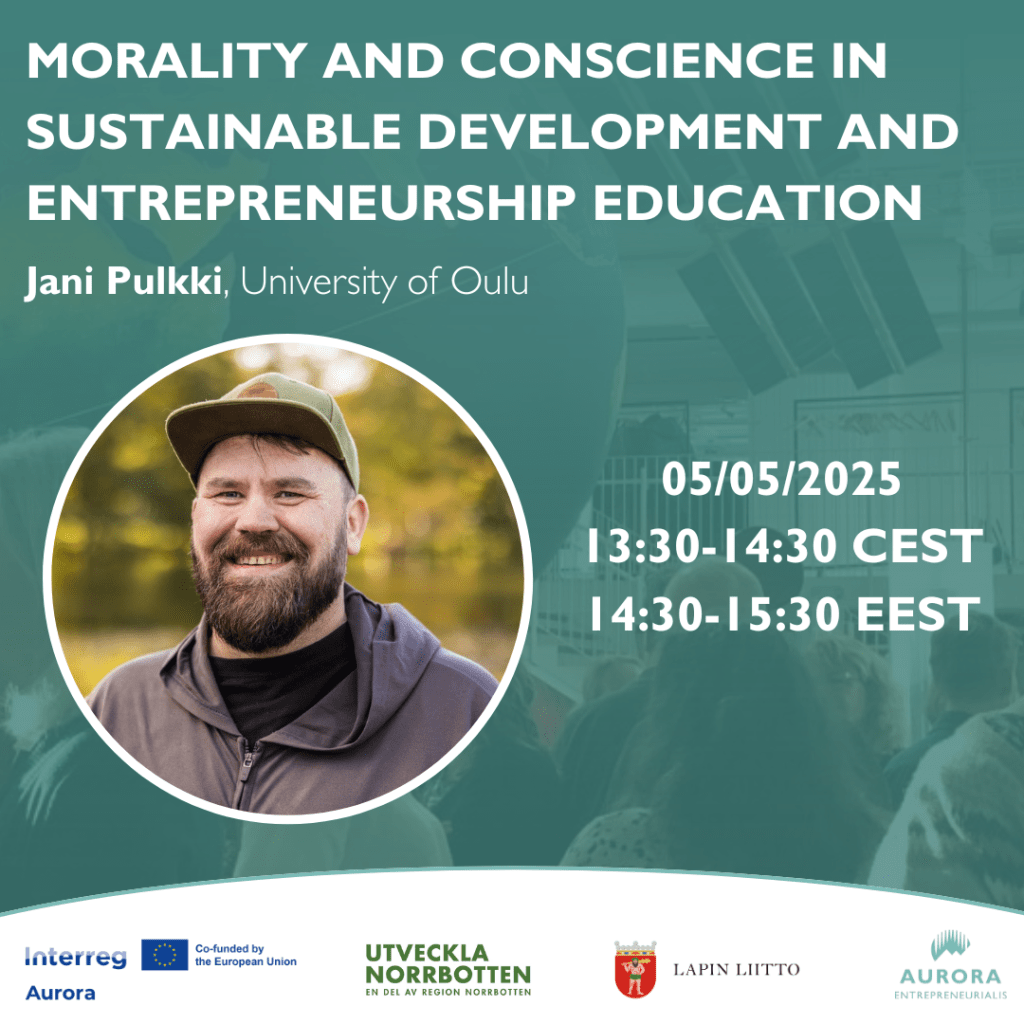
Morality and conscience in sustainable development and entrepreneurship education – Seminar 5 May 2025

How can morality and conscience be addressed in basic and upper secondary education, especially when talking about nature, sustainable development, future working life and entrepreneurship? 

POISED researcher PhD. Jani Pulkki from the Faculty of Education and Psychology (University of Oulu) discusses the concept of ecosocial conscience and how the modern day relationship to nature has come to be. The seminar will focus on the role of the teacher when addressing questions of morality and conscience, especially in the contexts of nature, human impact on nature, sustainable development topics and entrepreneurship education.

Jani Pulkki is a postdoctoral researcher specialising in themes such as educational thinking, including ethical, social, and ecological questions. He is also interested in environmental philosophy, environmental education, indigenous wisdom traditions, and other alternative traditions to Western worldviews. He has also studied questions of moral economy and contemplative pedagogy. For more details see here. (Linked from https://www.interregaurora.eu/)

Teemanumerokutsu itsekasvatuksesta

POISEDin Jani Pulkki ja Johanna Kallio toimittavat Aikuiskasvatukseen teemanumeron itsekasvatuksesta.

Itsekasvatus ajassa, Aikuiskasvatus 3/2026

Itsekasvatuksella viitataan aikuisikään sisältyvään kasvatustoimintaan, jolla ihminen pyrkii itse tavoitteellisesti laajentamaan oman ymmärryksensä ja toimintansa näköaloja.

Itsekasvatus tarkoittaa ensinnäkin toimintaa, jolla kehitämme itsetuntemustamme. Toiseksi se merkitsee yhteiskunnallisten ja eettisten käytäntöjen kehittämistä yhdessä muiden kanssa. Vallitseva aika kutsuu meitä muuttumaan ja muuttamaan yhteiskunnallisia rakenteita ympärillämme.

Teemanumero avaa erilaisia tapoja lähestyä itsekasvatusta ajassa. Näkökulmat valottavat itsekasvatuksen monipuolisuutta osana globaaleja itsekasvatuskäsityksiä, viisausperinteitä, kansalaisaktivismia sekä suomalaisen yhteiskunnan historiaa. Itsekasvatusta tarkastellaan myös harjoituksena, jonka avulla voidaan kultivoida totutusta poikkeavia tapoja elää ja toimia.

Etsimme teemakokonaisuuteen empiirisiä ja filosofis-teoreettisia tutkimuksia itsekasvatuksesta 2020-luvulla. Haemme numeroon tiedeartikkeleita, näkökulmia, puheenvuoroja ja kirja-arvosteluja esimerkiksi seuraavista teemoista:

  • mitä itsekasvatus voi olla ja mitä sillä tavoitellaan
  • itsekasvatuksen käytäntöjen nykymuodot ja kritiikki
  • arkiset ja marginalisoituneet itsekasvatuksen käytännöt
  • itsekasvatus aktivistisena käytäntönä ja kansalaisvaikuttamisena
  • itsekasvatus aikuiskasvatuksen instituutioissa
  • itsekasvatuksen ihmiskäsitykset ja arvokysymykset
  • itsekasvatuksen historia ja perinteet.

Numeron toimittavat Jani Pulkki ja Johanna Kallio. Se ilmestyy syyskuussa 2026.

Osallistu

  • Lähetä tiedeartikkelin käsikirjoitus viimeistään 5. marraskuuta 2025. Näkökulmien, puheenvuorojen ja kirja-arvioiden käsikirjoituksia odotamme vuoden 2026 alkupuolella. Meilaa tekstisi toimituspäällikölle: terhi.kouvo@kvs.fi.

New Article on the History of Datafication in Education

Datafication is often portrayed as a revolutionary development within and beyond educational governance. It is believed to usher in novel modes of governance, foster new relationships between private and public entities, and introduce innovative data technologies along with new forms of research and scholarship.

Amid the prevailing focus on what’s new , Antti Saari examines the ghosts of data futures past. He delves into the historical continuities of datafication in education, shedding light on the overlooked aspects of past data revolutions and their varying success in driving substantial changes within the field of education.

You can access the article here (open access)

Examining the psychologization of student subjectivity in Finnish universities

In a recent article in Sociological Research Online Antti Saari, together with Kristiina Brunila and Saara Vainio (University of Helsinki) analyze the assemblages involved in constructing the university student as a mentally vulnerable individual.

Abstract: Public debate and media attention concerning mental health problems, stress, psycho-emotional vulnerabilities, and anxiety among university students has reached record level. Informed by media representations, student mental health guides, and our observations, we focus on the ethos of vulnerability as an articulation of psychologized student subjectivity in Finnish academia. We explore the multiple registers in which the ethos of vulnerability tends to operate as an assemblage to depict and govern student subjects.

You can access the OA article The Psychologization of Student Subjectivity in the Finnish Academia here.

New Article: Proustian lessons on self-cultivation

In a recently published article in Philosophical Inquiry in Education, Antti Saari and Jan Varpanen discuss the cultivation of desire from a psychoanalytic point of view.

Abstract: Taking Marcel Proust’s In Search of Lost Time (À la recherche du temps perdu) as a literary vehicle, this article uses a psychoanalytic lens to examine the problem of what to do with our desires in the philosophy of education. The article describes an apprenticeship, a personal process of learning in which an ethical rapport with desire can be established. Apprenticeship entails a temporal relationship called “afterwardsness” (Nachträglichkeit), in which the subject constructs the truth of its desires in hindsight. This result can only be achieved by first failing to see the possibility of attaining the object of desire and then eventually coming to understand the nature of desire in general. While others have framed the relationship between desire and education in terms of either fulfilling one’s desires or questioning their desirability, we argue that a more lasting ethical attunement to desire can be found via an apprenticeship in failure.

You can read the article (open access) here.