The Palgrave Handbook of Science and Technology Studies in Education, brings together leading scholars working at the intersection of Science and Technology Studies (STS) and educational research. The handbookexplores how knowledge, technologies, infrastructures, data, expertise, and material practices shape educational systems and experiences.
The handbook demonstrates the growing importance of STS perspectives in educational research. Across its six thematic sections, contributors explore topics ranging from actor-network theory, educational technologies, testing and assessment, and data infrastructures to governance, artificial intelligence, and the history of educational knowledge. Rather than treating technologies as external forces acting upon education, the volume examines how educational practices and technological developments are co-produced through complex social, material, and political relationships. [
POISED member Antti Saari served both as one of the editors and as an author in the collection. His chapter, “Technologies of Objectivity: Laboratory Research in Early Twentieth Century Experimental Pedagogy” investigates how the concept of “objectivity” was historically constructed within experimental educational research and how laboratory methods, instruments, and research practices helped shape what counted as valid educational knowledge.
A major new handbook is set to contribute significantly to research at the intersection of education and Science and Technology Studies (STS): The Palgrave Handbook of Science and Technology Studies in Education.
Bringing together an international team of editors and contributors, the volume addresses an increasingly important area of scholarship. It focuses on the dynamic interplay between science, technology, and educational practices, offering a comprehensive overview of current developments in this emerging field. The handbook assembles diverse strands of research that connect STS perspectives with education, providing the first extensive state-of-the-art reference for this subfield.
A key strength of the volume lies in its combination of theoretical and empirical work. The chapters draw on a range of perspectives and methodologies, reflecting the interdisciplinary nature of both STS and educational research. This combination allows the book not only to map current debates but also to highlight new directions and future challenges for researchers.
The handbook isa central reference point for scholars interested in how technologies, infrastructures, and scientific practices shape—and are shaped by—education. In doing so, it provides a platform for advancing dialogue between disciplines that are often treated separately, but which increasingly intersect in contemporary research and policy discussions.
Further details about the volume can be found here.
Contemporary platitudes regarding interconnectedness abound. From connectography to the network society, from appeals to forces such as qi, prana and power to ‘stress contagion’ between teachers and students, from the legacies of colonialism to artificial intelligence, we are encouraged to understand ourselves as embedded, interconnected, in circuits, matrices, systems and fields.
The role of technology in mediating and producing such new sensibilities, potentials, and issues, and in cutting off other possibilities, is integral to today’s versions of interconnection. Debates over interconnection, however, can slide over the flashpoints that emerge, reshape, and reformulate issues across geopolitical regions, cosmologies, timespaces, species, institutions and more. This series considers these flashpoints – moments of seeming irresolvabiity generated within cross-philosophical clashes, connections, contacts and negotiations – as urgent sites of study in the Now and for rethinking educational futures.
The Flashpoint series is dedicated to analysing flashpoints within educational settings that are mediated by or involve technological inventions.
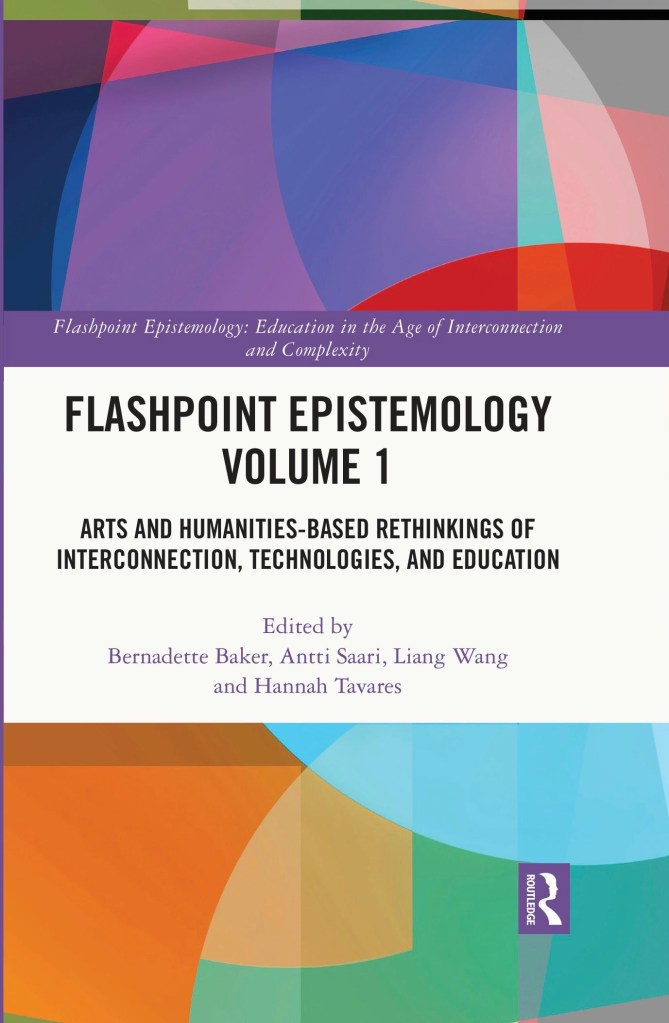
Volume 1: Arts and Humanities-Based Rethinkings of Interconnection, Technologies, and Education examines contemporary collisions and reworkings of cultural-political issues in education through arts and humanities-based approaches. How and whether lines are (re)drawn in educational practice – and via who-what – between justice, morality, religion, ethics, subjectivities, intersectionality, the sublime, and the senses are a particular focus. The volume offers innovative relational approaches and new narrativization strategies, examining the aporia experienced when operating in educational domains of inevitable, recurring, difficult, fortuitous, and/or unforeseen flashpoints.
The chapters will engage researchers seeking new approaches to education’s complexities, nested discourses, and ever-moving horizons of enactment. It will also benefit post/graduate students and teachers whose work intersects with sociological, philosophical, and cultural studies and who are curious about claims to interconnection, the ethical quandaries embedded in practice, and the affordances and limits of technological innovation.
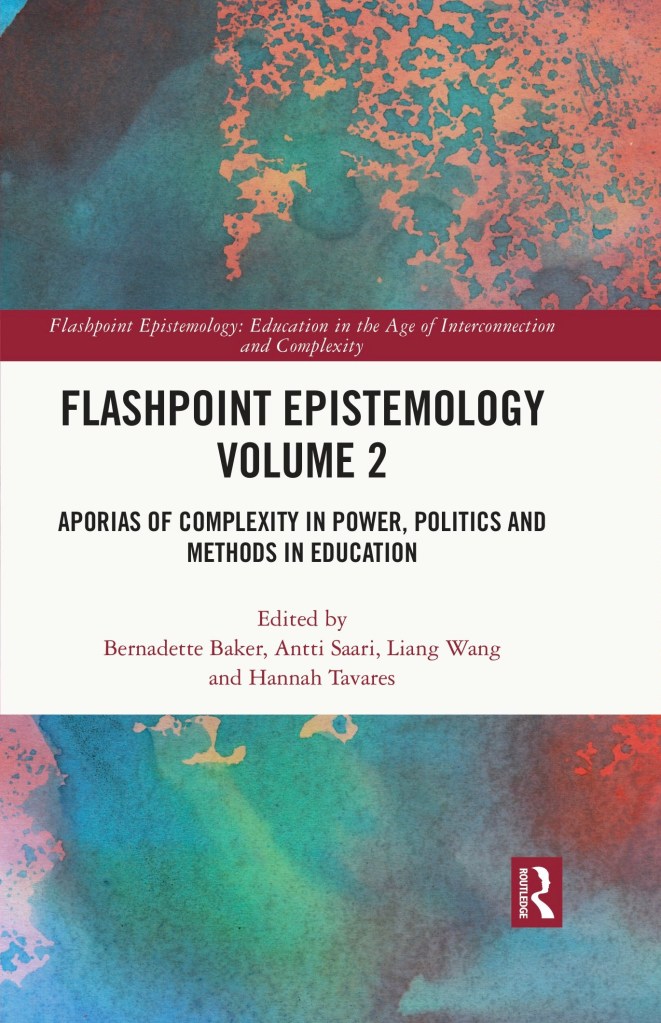
Volume 2: Aporias of Complexity in Power, Politics and Methods in Education brings creative sociopolitical research perspectives to flashpoints that emerge amid appeals to globalization, synoptic policy approaches, and new technologies – however defined. The chapters challenge prevailing notions of distance and difference, comparative philosophy, worlding practices, and contact zones. In the remaking of subjects, the unhoming of geopolitics, and new approaches to relationality, youth, and classrooms, complexities in preserving and questioning identity are laid bare and renovated. How technologies challenge and redefine racialization, engendering, and inter/nationalization are examined amid the reworking of oppression, success, well-being, politics, method, and power.
The volume will be beneficial for researchers seeking new approaches to education’s complexities, nested discourses, and ever-moving horizons of enactment. It is also a key text for post/graduate students and teachers interested in technological impact, globality, policymaking, and new ways of conducting research in contexts of digitalization and social media.