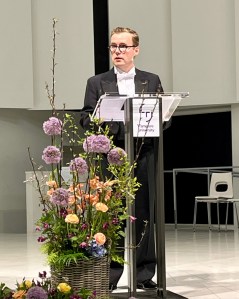
Antti Saari’s Inaugural Lecture

Professor Antti Saari delivered his inaugural lecture at Tampere University on May 11th, offering a wide-ranging reflection on the role of educational science in shaping how schooling is understood, governed, and transformed. Drawing on historical examples and his own research, he examined how educational expertise has long promised to make learning and teaching more precise, effective, and responsive to societal needs, while also raising critical questions about the assumptions underlying these ambitions.

Saari began by revisiting early twentieth‑century visions of education, which framed empirical research as a means to fully understand learners and optimise teaching accordingly. He showed how this aspiration has persisted, fuelling efforts to align education with societal demands through clearly defined objectives, methods, and evaluation techniques. At the same time, his lecture emphasised that educational knowledge is deeply entangled with power: concepts, theories, and modes of reasoning do not simply describe education but actively shape policies, institutional practices, and everyday school life. From statistical methods in assessment to the design of learning environments, educational expertise influences how education is organised while also narrowing and enabling particular possibilities.

In closing, Saari called for a more critically informed approach to educational development. He challenged the widely accepted idea that schools must always “keep up with the times,” arguing that such future‑oriented thinking often neglects historical insight and leads to recurring mistakes. Rather than offering quick solutions, he positioned educational research as a field that should interrogate its own assumptions, surface overlooked alternatives, and situate change within longer historical trajectories. In doing so, education can be understood not only as a tool for the future, but as a historically grounded and evolving social practice in its own right.

You can watch the lecture here (available until May 25th).

Pasi Takkisen artikkeli kestävyydenjälkeisestä ajasta

Väitöskirjatutkija ja kasvatusfilosofi Pasi Takkinen tutkii kestävyydenjälkeistä aikaa eli post-sustainability-käsitettä, joka ilmentää tutkijoiden epävarmuutta ja huolta kestävyyden tulevaisuudesta. Hänen keväällä 2025 julkaisemansa laaja kirjallisuuskatsaus tarkastelee eri tieteenalojen keskustelua siitä, onko kestävyyden käsite enää relevantti ja mitä kestävyydenjälkeinen aika voisi tarkoittaa.

Tutkimuksen mukaan antroposeenin edetessä perinteinen kestävyyskäsitys on joutunut kyseenalaistetuksi, ja monet tutkijat pohtivat, millainen tulevaisuus on mahdollinen, jos kestävyyttä ei enää voida saavuttaa. Kestävyydenjälkeinen aika viittaa tilanteeseen, jossa epäjatkuvuudet ja kriisit korostuvat, ja tarvitaan uusia lähestymistapoja tulevaisuuden hahmottamiseen. Lue lisää Tampereen yliopiston julkaisemasta tiedotteesta.

Artikkeli: Takkinen, P. (2025). Post-sustainability: A hermeneutic literature review. The Anthropocene Review, 0(0). DOI: 10.1177/20530196251339474

The Hidden Histories of the “Attention Crisis” in Education

In an era of digital distractions and AI-driven media, strategies to reclaim focus—like meditation, unplugging, and reconnecting with nature—are widely promoted. But what if our understanding of attention is shaped by deeper historical forces?

A new open-access article in Educational Theory by Antti Saari and Bernadette Baker explores the long-standing connections between attention, spirituality, and education. The authors trace contemporary concerns about the “attention crisis” back to European Christian monastic traditions, where disciplining attention was tied to both personal transformation and practices of Othering.

Their research uncovers how medieval vigilance and soul-governing techniques became embedded in Christian empire-building, influencing modern educational approaches to focus and distraction. By examining these historical trajectories, the authors reveal how today’s discussions on attention remain entangled with spiritual binaries and exclusionary logics.

Read the full article here.

New Article on the History of Datafication in Education

Datafication is often portrayed as a revolutionary development within and beyond educational governance. It is believed to usher in novel modes of governance, foster new relationships between private and public entities, and introduce innovative data technologies along with new forms of research and scholarship.

Amid the prevailing focus on what’s new , Antti Saari examines the ghosts of data futures past. He delves into the historical continuities of datafication in education, shedding light on the overlooked aspects of past data revolutions and their varying success in driving substantial changes within the field of education.

You can access the article here (open access)